
To find out which side of the fence is yours, I’d start by checking my property deed and title documents for boundary marks. These are official papers that came with my home purchase. I’m looking for a “T” symbol pointing toward my property—that means I own that side. If I see an “H” mark instead, it means I share ownership with my neighbor.
If my documents are unclear or hard to read, I can check the Land Registry online at gov.uk for official boundary plans. This is a government database with recorded property information. A surveyor—someone trained to measure and map property lines—can also help me interpret confusing marks if I’m still unsure.
The key is starting with what I already have at home. My deed or title will have the most reliable information about my boundaries. Once I locate those marks, I’ll know exactly which side of the fence belongs to me.
Start With Your Property Deed and Title Documents
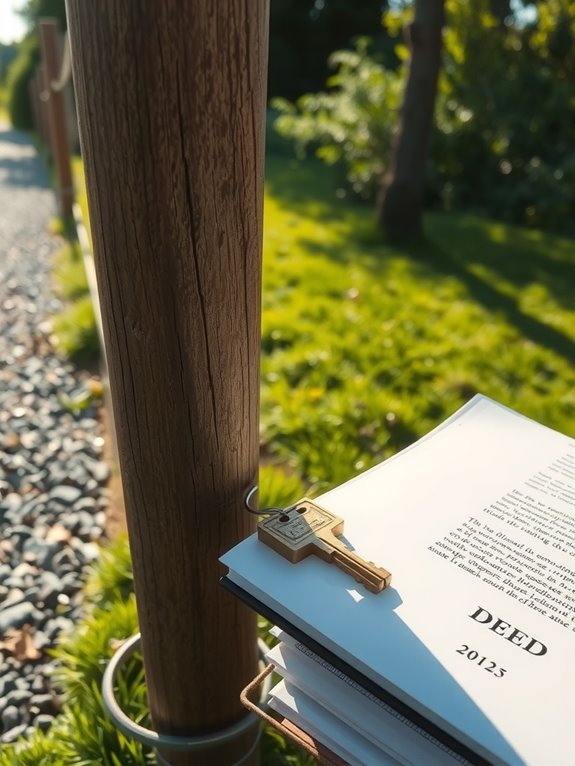
Your property deed is the first place I’d look when figuring out which side of the fence is mine. I’ll examine the deed plan carefully because it might list the ownership location or show boundary ownership right on the plan itself.
Next, I check my title plan for boundary marks. A “T” symbol means one side owns it. An “H” means it’s a shared boundary. These marks tell me who handles fence maintenance.
The Land Registry plans show which side owns the fence. A registered boundary with a “T” usually signals ownership on that side.
If my deed plans are unclear or missing, I request copies from my solicitor. I can also access Land Registry online for a small fee to view the official plan and confirm boundary ownership details.
Find the ‘T’ Mark That Shows Your Fence Responsibility
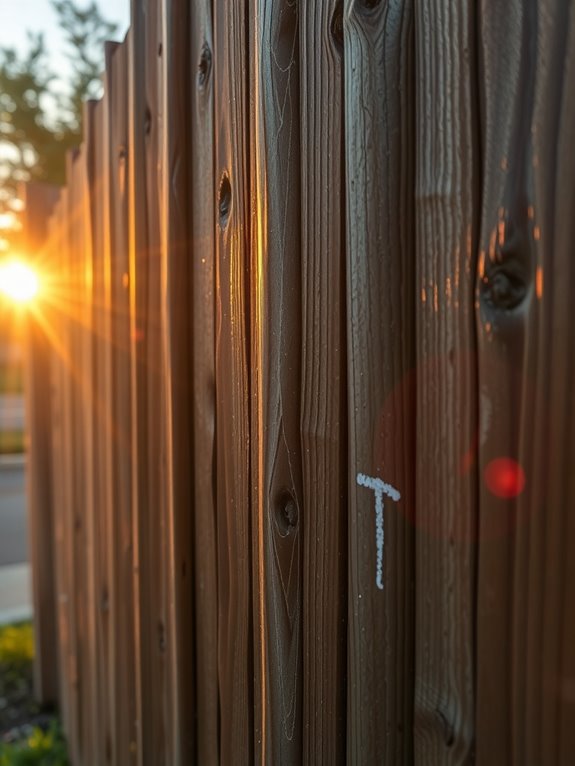
You’ll find a “T” mark on your boundary plan that shows which side of the fence you’re responsible for maintaining. The “T” mark points toward the property owner who needs to take care of that fence section.
I’ll walk you through locating these marks on your official documents. First, grab your property deed or the boundary plan that came with your home purchase. Look for the property lines drawn on the document. The “T” marks appear along these lines, and they’ll point in one direction or the other.
Here’s what the mark means for you. If the “T” points toward your property, that’s your fence to maintain. If it points away from your property toward your neighbor’s side, they’re responsible for upkeep. The mark is basically an arrow telling you who owns the maintenance duties.
When you look at your boundary plan, you might see multiple “T” marks along different fence sections. Check each one separately since you could be responsible for some sections and your neighbor could handle others. This is common when properties have multiple fence lines.
Understanding these marks helps you figure out exactly where your maintenance duties begin and end. You won’t have to guess or ask your neighbor about responsibilities. The boundary plan gives you the clear answer you need.
Understanding The T Mark
So here’s how I figure out who’s responsible for maintaining a fence. The T mark on my boundary plan tells me exactly that. I look at the title deeds and Land Registry documents to find these marks.
A single T pointing toward my property means I own that side. That means I’m responsible for maintaining it. Two joined Ts forming an H symbol mean I share ownership with my neighbor. We both maintain the fence together.
Sometimes I won’t find any T marks at all. When that happens, I need to consult a surveyor or solicitor. They’ll review my official documents and clarify the ownership situation. I can’t assume anything about maintenance responsibility without checking these records first.
Locating Marks On Plans
Once I know what those T marks mean, the next step is actually finding them on my boundary plan. I’ll grab my property documents and locate the boundary plan that came with my deed. The T mark should appear right on the line that separates my property from my neighbor’s land. I’m looking for that small “T” symbol printed along the boundary lines.
If I can’t spot it clearly, I can request a clearer copy from the Land Registry. They keep official records of all boundary plans and ownership details. Sometimes a solicitor can help me interpret what I’m seeing on the plan.
The mark’s position tells me everything about my maintenance responsibilities. Finding this mark is honestly the easiest way to settle any fence questions I might have.
Interpreting Ownership Responsibility
Now that I’ve found the T mark on my boundary plan, I need to figure out what it means for my responsibilities. The T mark shows which side of the fence belongs to me and who has to maintain it.
Here’s what the marks mean:
- A T mark on my side means I’m responsible for repairs and upkeep
- An H symbol (which is two Ts joined together) means my neighbor and I split the maintenance duties
- The Land Registry plans can back up my boundary plan if there’s any confusion
- A party fence situation means I need to work with my neighbor on maintenance
If I want full control over a fence, I can look into a formal buyout to take over ownership completely. Understanding these marks helps me know what I’m responsible for and keeps things smooth with my neighbors.
Identify Shared Fences Using the ‘H’ Mark
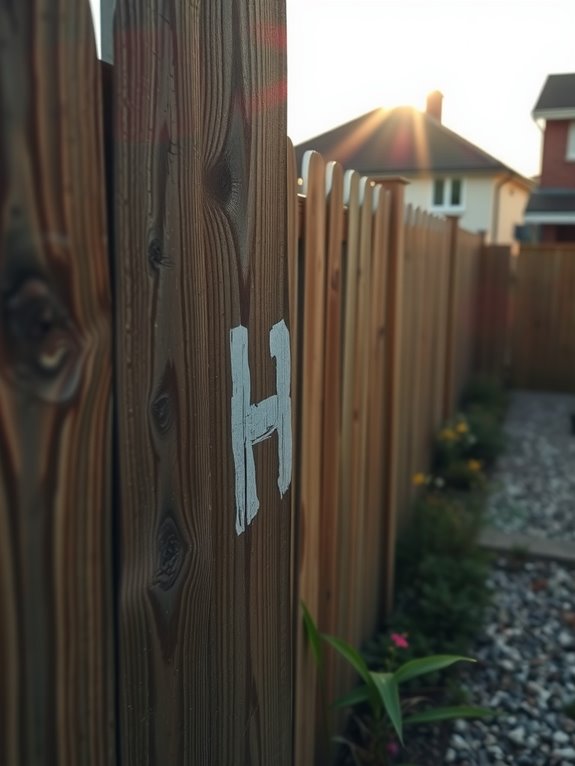
That little “H” mark on my boundary plan tells me I’m sharing fence responsibility with my neighbor. The mark is made of two T marks joined together. This symbol means neither of us owns the fence line exclusively—we’re looking at what’s called a party fence, and that changes how we split maintenance duties and costs.
I need to check my Land Registry records and title deeds to confirm this shared ownership. Once I verify the “H” designation, I can talk with my neighbor about splitting expenses. We might even create a boundary agreement to formalize things. This document protects both of us and makes it clear who pays for what repair work.
Check the Land Registry for Missing Ownership Details
What happens when your title deeds don’t mention who owns the fence? I’d check the Land Registry plans next. These official records show boundary ownership details that my title deeds might have missed.
If your title deeds don’t mention fence ownership, check the Land Registry plans for reliable boundary details.
I recommend these steps:
- Visit gov.uk to access Land Registry plans online
- Request official records directly from the Land Registry
- Review boundary plans carefully for ownership marks
- Pay any small access fees required
- Compare findings with my title deeds for complete clarity
The Land Registry maintains accurate boundary information for properties across England and Wales. I check these official records first because they’re reliable sources that protect my interests. Getting this sorted now prevents future disputes with neighbors.
Hire a Surveyor When Documents Don’t Clarify Your Boundary
If your property documents leave you scratching your head about where your boundary actually sits, I’d hire a licensed surveyor to sort it out. They can read those mysterious T and H marks on plans—those are abbreviations for property lines and corners—and tell me exactly who’s responsible for maintaining what section of the fence.
A surveyor creates a formal boundary report that I can use to settle disagreements with my neighbor and protect myself from future encroachment issues. This report shows the exact property lines and measurements so there’s no confusion about where my land ends and theirs begins.
When To Hire Professional
Sometimes I look at my deed and the Land Registry documents, and I can’t tell exactly where my boundary line sits. That’s when I need to bring in a licensed surveyor. They’ll interpret those tricky title deeds and spot the “T” or “H” marks that show boundary details. A surveyor gives me a formal boundary report that settles the confusion.
I’d want one because unclear deed descriptions create neighbor disputes. Surveyors interpret Land Registry plans accurately and identify maintenance responsibilities for each side. A boundary report gives me legal protection and prevents future fence ownership conflicts. Once I have the surveyor’s written findings, I can share the boundary clarification with my neighbor and move forward.
What Surveyors Can Clarify
Once I get that formal boundary report, I can see what a surveyor actually does to clear things up. Surveyors read my title deeds and Land Registry plans to confirm who really owns what. They also read legal markers like “T” or “H” marks that show who’s responsible for maintaining the boundary.
When my documents don’t match what’s on the ground, surveyors locate the exact boundary using stakes or monuments. This physical marking stops people from building on land that isn’t theirs. They spot any gaps between what I think is mine and what the official records say.
Their formal boundary description becomes solid evidence if disagreements happen later. I can then use their findings to work out disputes with neighbors or create boundary agreements that we all sign.
Understand Local Laws Before Making Changes
Why would I want to skip this step?
I need to understand my local laws before making changes to my fence. Here’s what matters to my situation:
- Boundary ownership varies by location and state
- Local laws dictate what I can and cannot build
- Fencing regulations set specific height limits and placement rules
- Permits prevent costly mistakes and legal disputes
- HOA guidelines may require approval before I start work
I should check my title plans and see what a surveyor indicates about ownership. In Texas, shared fences belong to both owners unless documented otherwise. England and Wales use boundary marks like “T” or “H” to show who’s responsible.
Before I touch my fence, I need to verify zoning requirements and get necessary permits. Skipping this step invites penalties and neighbor conflicts. I’m protecting my investment and keeping peace with my community by doing this right.
Settle Disputes With Your Neighbor First
Now that I’ve checked my local laws and know what I can and can’t do, I need to talk with my neighbor before making any moves on that fence.
Before making any fence decisions, check local laws and have a calm conversation with your neighbor.
I’ll start with a calm, direct conversation. I should bring my title deeds and any boundary documentation I’ve found. These documents show who owns the boundary and who has to maintain it. The “T” or “H” marks on my deeds tell me who’s responsible for which side.
If the conversation gets difficult, I can propose a written boundary agreement. This spells out who pays for what and who does the work. If I can’t agree with my neighbor, mediation helps. A neutral third party will work with both of us to find a solution without things getting heated.
After we agree on something, I should have a legal expert review it. They’ll check that everything is correct and that it actually settles the dispute.
Put Your Fence Agreement in Writing
How do I make sure my neighbor and I stay on the same page about that fence? I put it in writing. A written agreement clears up potential conflict between us.
Here’s what I include in my fence agreement:
- Exact boundary definitions that reference my title deeds or boundary plans
- Ownership clarification using “T” or “H” designations. The “T” means one person owns and maintains the fence. The “H” means both of us share ownership and costs.
- Specific maintenance duties and repair costs for each party
- Access rights so either of us can reach the fence to fix it
- Replacement procedures if the fence needs major work
- Update provisions if ownership or boundaries change later
I sign and date the document. I also ask a legal professional to witness it. This makes the agreement hold up if we ever need to prove what we decided together.
When disputes come up later, I’ve got proof of what we both agreed to. It’s the smartest move I can make for my shared boundary.