Your electric fence needs at least 2,000 volts to work, but I’d recommend 3,000 volts for reliable containment. That steady voltage matters more than occasional voltage spikes that fade fast. The exact amount depends on your animal. Horses need 2,000–3,000 volts, while goats and sheep need 4,000–5,000 volts. Cattle typically do best at 3,000 volts.
I find that vegetation touching the fence and poor ground connections kill your voltage fast. You’ll want to keep up with maintenance to protect your system’s power. Keep reading to learn what actually drains your setup.
The Minimum Voltage Your Electric Fence Needs to Work
How much voltage do you actually need to keep your horse safely contained? I’ve found that 2,000 volts is the bare minimum for effective containment. I recommend aiming for 3,000 volts for reliable training and consistent results. That extra voltage helps your fence deliver a quick, corrective shock through your horse’s coat, even when seasonal changes and vegetation loads weaken the system.
I’ve learned that maintaining steady voltage across your entire fence matters more than occasional voltage spikes. A fence delivering consistent 3,000 volts everywhere works better than one with high peaks that fade at distant points. Think of it this way: I’m building a reliable barrier, not a sporadic one. That consistent voltage is what keeps containment effective throughout the year.
Animal Type Determines Your Voltage Requirements
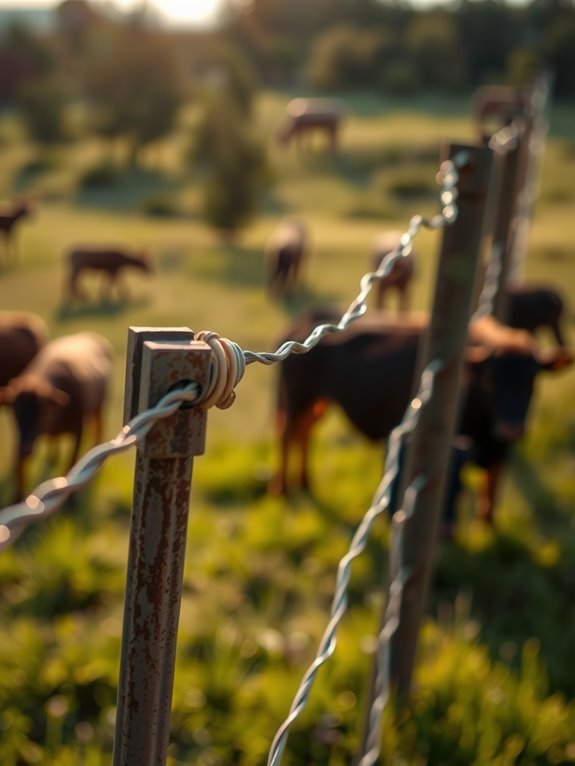
Different animals need different voltage levels, and that matters when I’m setting up a fence. I can’t use the same voltage for every animal type.
Horses typically need 2,000–3,000 volts to stay contained. Goats and sheep require higher voltage—around 4,000–5,000 volts—because their wool insulates them from shocks. Bulls and larger cattle demand the upper range of 2,000–3,000 volts to prevent aggression.
Wild animals like deer and elk need 4,000–5,000 volts since they’re easily spooked and can jump high fences. Pigs and small nuisance animals start lower at 2,000 volts or less, though rooting behavior sometimes pushes me toward higher settings.
When I choose a voltage, I consider three things: the animal’s size, its behavior, and my fence design. These factors help me pick the right voltage reading for whatever animal I’m keeping contained.
Why 3,000 Volts Is the Effective Threshold for Cattle
When I’m working with cattle, I’ve learned that 3,000 volts is the sweet spot for keeping them contained. The key is maintaining consistent voltage across your entire fence instead of letting it spike and drop. Cattle need steady shock delivery through their coat, so I can’t rely on voltage spikes that disappear elsewhere on the line.
Several factors pull your voltage down over time. Vegetation contact reduces the delivered volts to your animals. Long fence runs naturally decrease voltage delivery. Poor grounding quality affects how well the shock works. Seasonal growth lowers your fence performance. Wire condition influences how cattle respond to the shock.
I recommend choosing an energizer with extra buffering capacity. This accounts for seasonal vegetation and distance challenges that naturally pull your voltage down. The extra power handles those real-world conditions without you having to constantly adjust settings.
Voltage vs. Joules: Which One Actually Matters More?
When you’re sizing up an electric fence, voltage matters most. Voltage is the electrical pressure that pushes current through vegetation or an animal’s coat to deliver a shock. Joules measure the energy in each pulse, and they do matter, but here’s the real difference: a fence that spikes to 5,000 volts for a split second then drops to nothing won’t work nearly as well as one holding a steady 3,000 volts the whole way. I focus on voltage consistency first because maintaining your target voltage under real-world conditions—with wet grass, weeds, and seasonal changes draining your power—beats chasing momentary peaks. A steady, reliable voltage keeps your fence working when it counts.
Voltage’s Primary Role
Why’s everybody so obsessed with cranking up the voltage when what really counts is keeping it steady across your entire fence?
I’ll be honest. Voltage does the actual work of pushing current through resistance. I’m talking around 3,000 V as a solid target for most setups. But here’s where I see people get it wrong. A steady 2,000–3,000 V that stays consistent beats occasional spikes every single time.
Think about it. Vegetation and seasonal changes create voltage drops along my fence line. I need reliable delivery more than I need peak moments. My fence works best when it maintains uniform voltage throughout. That consistency trains animals effectively and keeps them contained. I’m building a system that works dependably, not chasing numbers.
Joules And Energy Delivery
So I’m keeping my voltage steady at 3,000 V across the fence line—that’s the basic setup. Now I need to talk about joules, which measure the energy my fence delivers with each pulse. Here’s the thing: I need both voltage and joules working together. Voltage pushes the current through animal coats. Joules provide the energy punch. But voltage takes the primary role in how well this works.
| Energizer Type | Stored Joules | Output Joules | Real Performance |
|---|---|---|---|
| Small unit | 2 | 1.4 | Good for short fences |
| Medium unit | 5 | 3.5 | Standard farm use |
| Large unit | 10 | 7 | Better for heavy vegetation |
My output joules run about 70% of my stored joules. I follow this rule: I need roughly one output joule per mile of fence. That’s my target for getting the effectiveness I want.
Consistency Over Peak Performance
I’ve learned that keeping my fence voltage steady matters way more than hitting some high peak number. A reliable 3,000 volts running the whole length of my fence line does a better job than a spike up to 8,000 volts that drops down to 1,500 volts by the far end.
My horses respect the boundary every single time when I maintain steady voltage throughout the whole perimeter. Here’s the thing—vegetation, ground moisture, and wire resistance all drain power as electricity travels down the line. That’s why I pick an energizer that’s a bit larger than the bare minimum. I’m building in a buffer that keeps the voltage steady even when seasonal changes hit.
I’d rather have reliable 3,000 volts everywhere than unpredictable spikes that fade fast. Consistent delivery means dependable protection.
How Many Joules Does Your Cattle Fence Need?
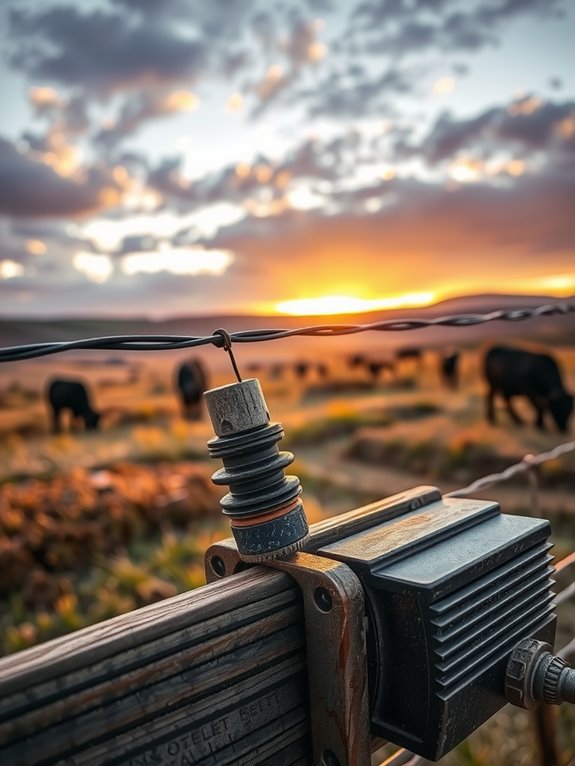
How do I figure out the right joules for my cattle fence? I use a practical formula: about one output joule per mile of fence. Most energizers deliver roughly 70% of their stored joules to my actual fence line. So if I’ve got a two-mile setup, I’ll want an energizer storing around three joules to make up for that energy loss. I pair this with my voltage goals of 2,000–3,000 volts minimum for cattle, or higher for bulls.
Here’s the thing though—joules alone don’t tell the whole story. I also consider grounding quality and weed growth because both dramatically affect how much actual volts reach my animals. Poor grounding or heavy vegetation contact can tank my fence’s effectiveness fast.
Common Voltage Mistakes to Avoid
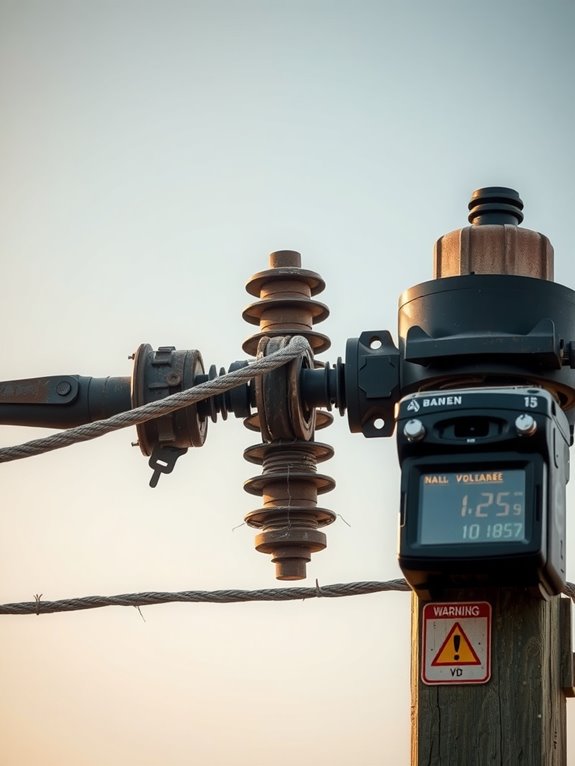
Why do so many folks think cranking up the voltage is the answer to everything? I used to believe more volts equals better performance. Here’s what I’ve learned: consistency matters way more than voltage spikes. I’m aiming for around 3,000 V across my entire fence line, not wild fluctuations.
I also make mistakes by ignoring voltage drops from weeds and poor connections. Seasonal vegetation loads and damaged insulators tank my readings at the far end of the fence. I used to rely on energizer readings during outages, thinking low voltage justified buying those “weed burner” models. That’s backwards reasoning.
I need appropriate joules per mile—roughly 1 J/mi—while maintaining steady target voltage. I skip the shortcuts. I address grounding issues and vegetation contact first. That’s where real improvement happens. I check my insulators regularly and clear weeds away from my fence line instead of just cranking up the power.
What Resistance Sources Kill Your Voltage?
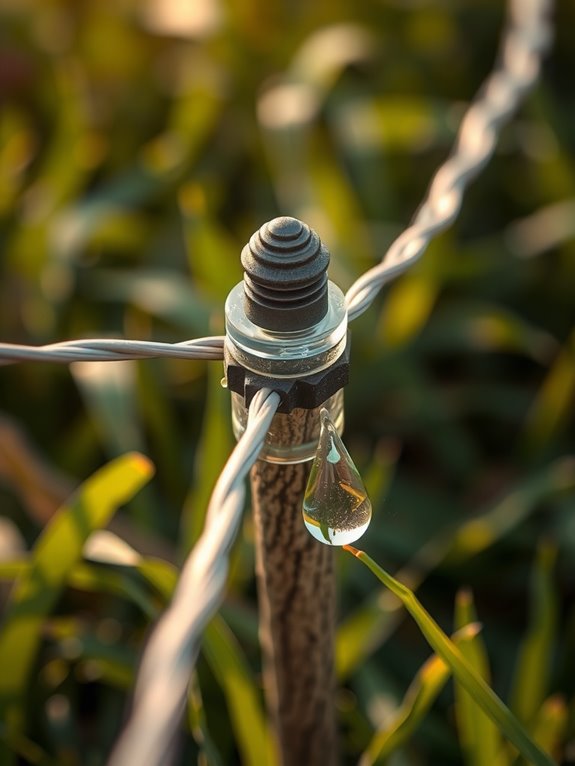
We’re going to talk about the invisible enemies that steal your fence’s voltage before it even reaches the animals. Weeds touching the wire, rusty connections, broken insulators, and moisture buildup all create resistance. This resistance eats away at your volts, and the problem gets worse over long distances because the wire itself adds even more resistance.
I’ll show you what causes these voltage drops and how you can stop them. The key is smart maintenance and picking the right wire for your setup.
Common Resistance Sources
Since voltage drop happens whenever electricity flows through resistance, I need to know what’s actually stealing my fence’s power. Weed load along the fence line is a big one. That vegetation draws current away before it reaches the animals. Ground conditions matter too because wet or dense soil affects how well my grounding works.
The physical stuff adds up fast. Bad connections, broken insulators, and rusted wires all crank up resistance. Loose clamps and oxidized connectors are sneaky problems I often overlook. When I stack these issues together, my fence loses serious voltage. A fence that should deliver 5,000 volts might only reach 2,000 by the time it travels the full distance.
I check these resistance sources regularly to keep my fence working right. That means inspecting my grounding system, trimming back vegetation, and tightening any loose connections I find.
Voltage Drop Along Fence
As electricity travels down your fence line, resistance in the wire gradually uses up your volts. The longer the distance, the bigger the voltage drop you’ll see. Vegetation touching the wire also pulls voltage down. Your ground connection quality matters a lot—a poor ground wastes power. Bad wire connections and rust make the problem worse.
Maintenance And Prevention Strategies
What’s actually draining your fence voltage? I’m losing power through several sneaky culprits that kill my system’s effectiveness. Here’s what I need to tackle for proper voltage maintenance:
| Resistance Source | Impact | Solution |
|---|---|---|
| Weed load | Drains 20-40% of voltage | Trim vegetation monthly |
| Bad connections | Creates power loss points | Check terminals quarterly |
| Rusted wires | Increases resistance | Replace corroded sections |
I’ve got to stay on top of grounding quality too. Poor ground rods let current escape uselessly. Broken insulators and vegetation contact create alternate paths that bypass my fence entirely.
I recommend inspecting my system seasonally. I look for rust, loose connections, and overgrown weeds touching the wire. I replace damaged insulators right away. This routine maintenance keeps my voltage strong and my animals safely contained.
Why Your Ground Connection Makes or Breaks Your Fence
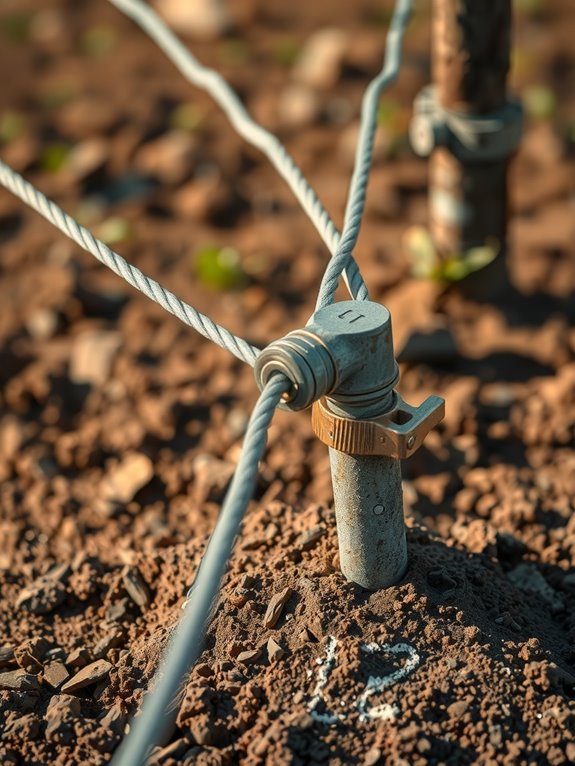
Your electric fence needs a solid ground connection to work. Think of it like a circuit board—the current has to have a path back into the earth, or the shock won’t stop your animals. Without good grounding, the voltage drops and your fence gets weak.
I drive multiple ground rods deep into the soil to create that return path. You’re aiming for 2,000–3,000 volts at your fence line. When the ground connection is corroded or loose, I’ve seen voltage disappear at the far end of the fence.
Here’s what I check regularly: the rods themselves, the wire connections, and the clamps holding everything together. Dry soil and vegetation touching the fence can both mess with your grounding quality. If your ground connection isn’t solid, your containment system just won’t hold up. That’s the difference between a fence that actually works and one that doesn’t.
Testing and Fixing Low Voltage
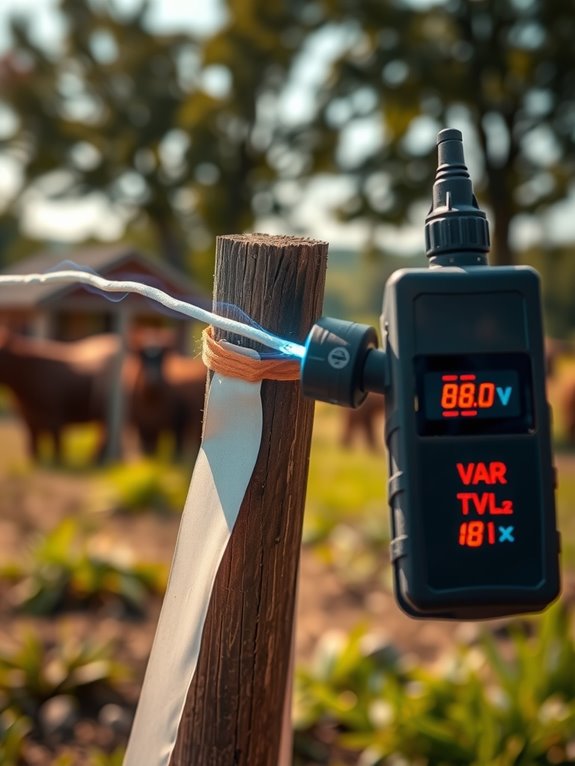
Why does your fence voltage drop when you need it most? I’ve dealt with this plenty of times. Here’s what I do to track it down.
I measure volts at multiple points along the line and near grounding spots. This tells me exactly where the voltage dips occur. I’m looking for readings around 3,000 volts for effective containment. If mine falls significantly below that, I address resistance and grounding first.
I trim vegetation touching the wire, tighten loose connections, and replace broken insulators. I also upgrade grounding conductors and stakes. These fixes deliver energy more efficiently through the circuit.
After I make corrections, I verify voltage recovers to target levels under load. I check consistency across long runs and different weather conditions. When I get this right, my fence works reliably.