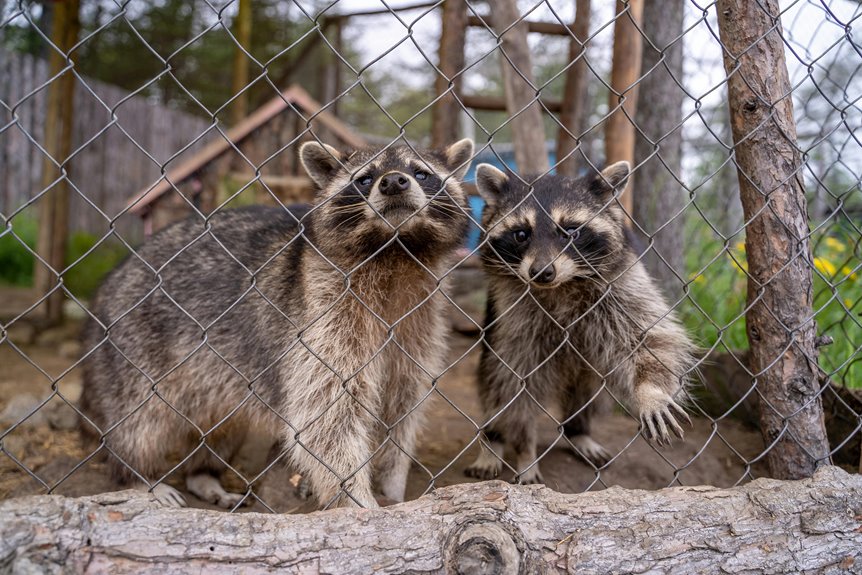
I’ve learned that raccoons are really good climbers because of how their bodies are built. Their front paws have five flexible digits, kind of like human hands, with sharp claws that dig into rough surfaces like bark and brick. This grip is what lets them scale fences and walls so easily.
Their hind legs do the heavy work of pushing them upward. Their long tail helps them balance on vertical surfaces so they don’t fall. Here’s the part that really gets me—their claws can rotate 180 degrees. That means they can back down a fence or tree headfirst without losing their grip. It’s basically their secret to moving in any direction they want.
When I’m thinking about protecting my property, understanding this anatomy helps me figure out what kind of barriers will actually work. I know I need to block access points where their climbing skills give them an advantage.
What Makes Raccoons Such Good Climbers
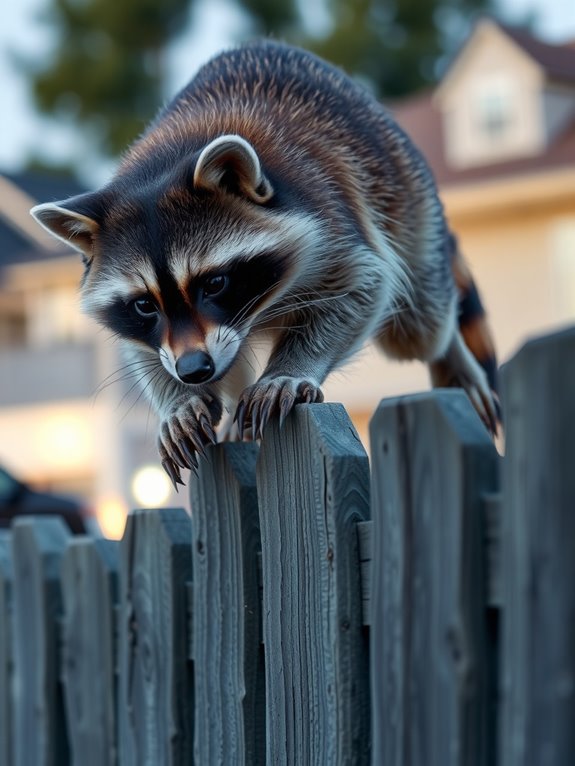
Ever wonder how raccoons scale fences and trees so easily? I’ll tell you what makes them such good climbers. Their front paws have five clawed digits that grip rough surfaces like bark and brick with real precision. Their hind legs are longer and have flexible ankles that rotate 180 degrees, which means they can twist their back legs almost all the way around. This lets them climb headfirst down trees and walls without losing their grip.
Their strong claws do two important jobs. They dig into surfaces for traction, which means better grip, and they provide stability so the raccoon doesn’t slip. Their front paws work a lot like human hands too. I can picture them grasping ledges and crevices as they pull themselves up during the climb.
Add in a long tail for balance and you’ve got a creature built for climbing. Raccoons use that tail to steady themselves on vertical surfaces like tree trunks, brick walls, fences, and even vinyl siding. That’s why I see them everywhere scaling the sides of houses and disappearing into gutters.
Raccoon Front Paws: Nature’s Gripping Tool
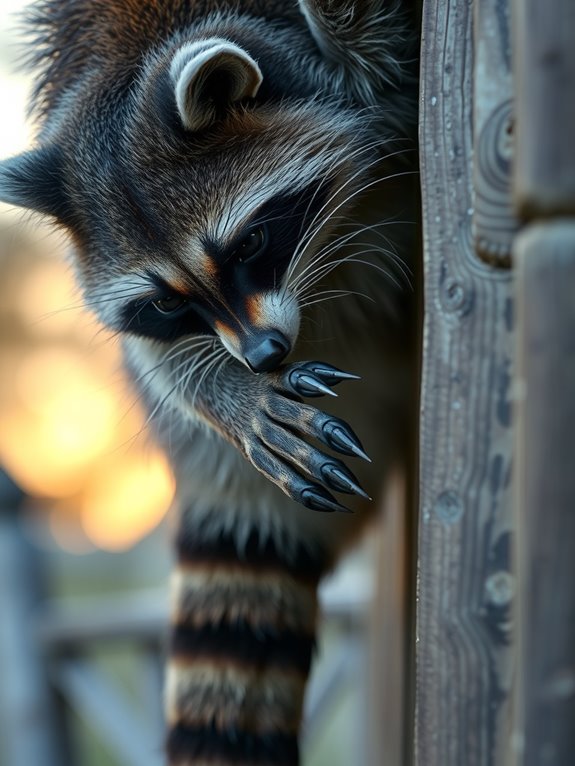
I’ve got to tell you about raccoon front paws because they’re basically nature’s gripping tool. Their paws look like tiny human hands with five toes and sharp claws. Those claws grip branches, fences, and brick walls with a lot of precision. The claws combined with their sensitive, flexible paws let raccoons scale almost any surface fast and secure.
Hand-Like Dexterity And Grip
What makes raccoons such good climbers? I’ve got to talk about their front paws. These paws work like human hands with five toes and sharp nails. Each nail digs into bark and rough surfaces for a solid grip.
Their paws let them grab tiny cracks and bumps on fences and trees. They can rotate around obstacles and squeeze through tight corners with ease. I’ve noticed they use their front paws to make adjustments while climbing. They pull themselves up with precision and control.
This hand-like dexterity is what sets raccoons apart from other animals. Their tactile paws give them the stability they need on vertical structures.
Claws For Climbing Traction
While their five-toed paws give raccoons that hand-like grip, their claws are what really lock them onto whatever they’re climbing. I’m talking about serious traction here. Their large, sharp claws dig into surfaces and create the stability they need to scale vertical obstacles.
Here’s what makes their claws work so well:
- Large, sharp points that penetrate rough bark and brick
- Secure attachment to tree trunks and power poles during ascent
- Reliable grip across diverse materials like fences and walls
- Strong grasp that prevents slipping on uneven textures
- Precise foothold creation on challenging surfaces
When I combine their dexterous front paws with these gripping claws, I get climbers that can tackle nearly any fence or structure I put in their path.
Long Claws Built for Scaling Fences and Walls
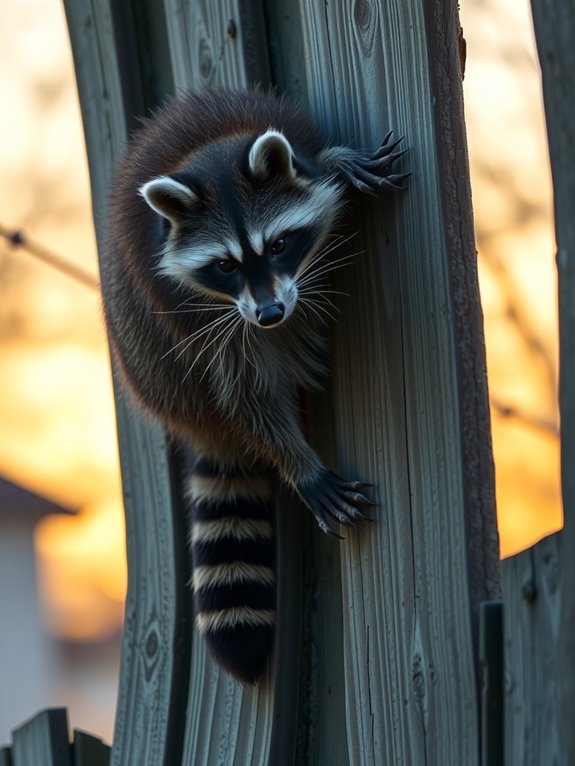
I’ve noticed that raccoons’ claws are really sharp and durable. They work almost like tiny hooks that dig into fence materials and create secure anchor points for climbing. The claws enhance grip by catching on wood grain, brick texture, and metal ridges. This means raccoons can pull themselves up surfaces that’d be impossible for most animals.
What I find interesting is how these claws can penetrate different materials. They dig into soft wood, rough concrete, and everything in between. This gives raccoons the traction they need to scale nearly any fence or wall they encounter.
Claw Structure And Function
Raccoons have front paws with five clawed toes that work just like tiny hands. Their climbing ability comes down to a few specific features that make them really good at scaling surfaces.
Each claw curves naturally and grips rough textures like tree bark and brick. The nails are dark and sharp enough to dig into wood, metal, and fence materials. Their paws also have what’s called an opposable design, which means they can manipulate small handholds with precision. This setup gives them strong traction on vertical surfaces and lets them move quickly up whatever they’re climbing.
What makes their paws work so well is the combination of grip strength and sensitivity. I noticed that raccoons can control their movement along ledges and crevices because their paws are sensitive to texture and touch. The curved claws maximize contact with whatever surface they encounter, whether it’s rough or smooth. That’s why these climbers scale your fence without much effort.
Grip Enhancement For Climbing
I figured out why raccoons are such good climbers. Their claws are basically built for gripping. The pads on their claws are dark and work like tiny suction cups against brick, wood, vinyl siding, and metal. When a raccoon climbs, those claws dig into rough spots and grab tight.
Their front paws are super flexible, kind of like our hands. They can grip ledges and fence posts with real precision. The claws aren’t just sharp though. They’re positioned so raccoons can pick which ones to use depending on what surface they’re climbing. Add in flexible ankles, and you’ve got a climber that doesn’t slow down much.
That’s why fences don’t really stop them. They’ve got the grip strength and flexibility to get over most obstacles pretty easily.
Material Penetration Capabilities
How do raccoons actually grip surfaces that seem way too smooth for climbing? I need to understand their claw strength. These creatures have specialized tools built right into their paws.
Raccoons have long, sharp claws that dig into brick and wood with serious force. Their claw strength lets them penetrate the irregular textures on fence surfaces. When I look at a raccoon’s paw, I’m seeing natural climbing equipment that works like a grappling hook. Their claws aren’t just for show. They’re built for gripping rough materials that’d stop most animals.
My observation is that raccoons have flexible hind ankles. These ankles rotate 180 degrees, which lets them do head-first descents down vertical surfaces. Their extended forelimb reach (the length of their front legs) allows rapid transitions between contact points during their climb. When a raccoon encounters my fence, its claw strength transforms it into a ladder. The creature grips beveled edges and notches as it ascends.
How Raccoon Hind Legs Power Every Climb
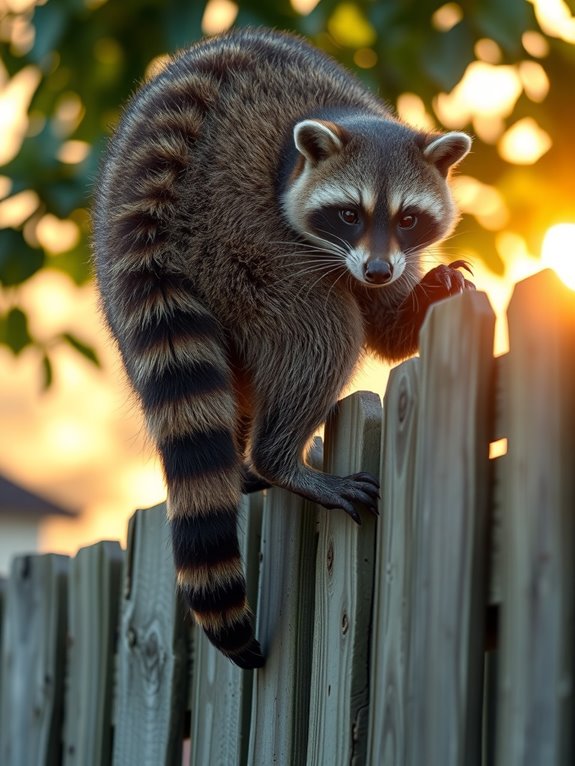
Ever wonder why raccoons can scamper up a fence like they’re riding an elevator? I found the answer in their hind legs. These powerful back legs do most of the work during climbs. Raccoons push upward with a lot of force from their hind legs, propelling their bodies up vertical surfaces fast.
Here’s the cool part about their feet. Their hind feet rotate a full 180 degrees, which lets them go headfirst down surfaces without losing their grip. I learned that their flexible ankles grip different materials like wood, brick, and bark really well.
When I look at how raccoons climb, I see it’s a coordinated system. Their strong front paws work with their hind legs and balancing tails to create a climbing setup that few barriers can stop. That’s why I see raccoons conquering fences so easily. Their body structure just makes them natural climbers.
The Rotating Ankles That Enable Headfirst Descent
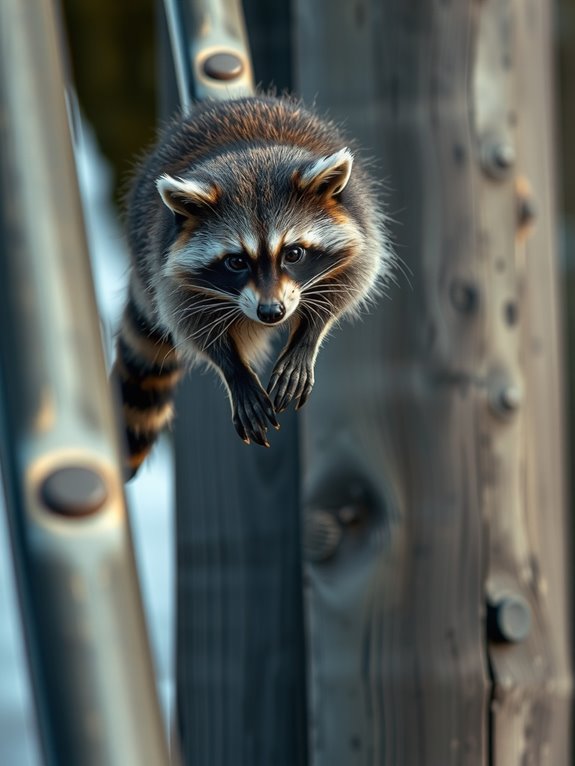
Now that I’ve covered how their powerful hind legs work during climbs, let me explain what makes their descents so smooth. Raccoons can rotate their hind feet 180 degrees. This ankle rotation is what lets them navigate downward in ways we can’t.
Here’s why this skill matters:
- I can see how it lets them descend headfirst down tree trunks and vertical surfaces
- It allows their feet to reposition for controlled exits without jumping
- They can reverse direction quickly when leaving branches
- Their balance stays steady while they shift from climbing to lowering
- The grip stays secure throughout the entire descent
This ankle flexibility turns something risky into routine for them. They can back down surfaces with real control. That’s what separates a skilled climber from an exceptional one.
Why Your Fence Is a Highway to Your Roof
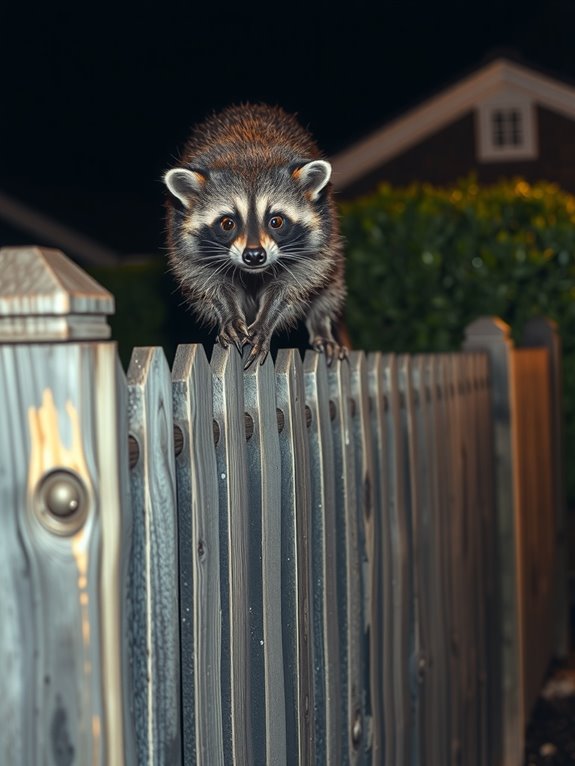
Your fence isn’t just a barrier. It’s basically a raccoon highway that connects directly to your roof. When trees grow near your property or your fence runs close to a corner of your house, raccoons use these natural bridges to bypass the fence altogether and climb straight up to your roof. Once they’re up there, they’ve found shelter, a vantage point to scout for food, and a safe place away from ground predators.
Tree Branches As Bridges
Have you ever wondered how raccoons get onto your roof so easily? I’ve learned that tree branches work like natural highways for these animals. Let me break down what I found:
Raccoons use branches as pathways that lead straight from the ground to your roof. Their hind legs grip branches with serious strength. Their long tails help them balance while they move across narrow limbs. Plus, thick tree canopies give them multiple routes and places to hide while they climb. Once they’re on a branch near your house, they can hop onto your eaves without much effort.
I can stop this by pruning branches that hang within three feet of my home. This means cutting back any limbs that get too close to my roof or walls. When I remove these branches, I take away their main climbing routes. It’s a straightforward way to make it much harder for raccoons to reach my roof.
Direct Access To Roofs
Why do raccoons seem to treat fences like climbing gyms? I’ve discovered that your fence creates a direct highway to your roof. Raccoons climb up wood, vinyl, or brick fences and reach your roofline in seconds. Their front paws work like hands with sharp claws that grip every surface. Their flexible hind legs bend at angles that let them move vertically without much effort.
Once they’re on your fence, the eaves and roof edges become easy targets. I notice that a fence positioned near your home cuts down the climbing distance they need to cover. Your gutter becomes their entry point into the attic. I’ve found that removing fence access actually reduces roof invasions pretty significantly.
The solution I’m working with involves moving any fences at least 6 to 8 feet away from your home’s foundation. If that’s not possible, I trim back tree branches that hang over the fence or touch your roof. I also install a metal barrier called a fence topper along the top edge. This 18-inch extension angles outward and prevents raccoons from gripping the top and pulling themselves up. The barrier works because it removes the solid grip point they need to climb higher.
Stop Raccoon Climbing: Physical Barrier Solutions
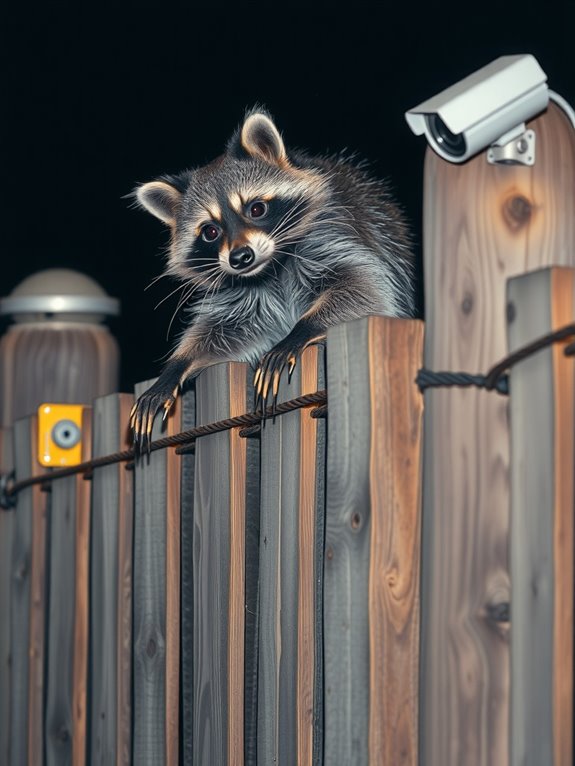
Given what we know about raccoons’ climbing abilities, standard fences alone won’t keep them out. I need to get creative with physical barriers that actually work.
Standard fences alone won’t stop determined raccoons—creative physical barriers are essential for effective property protection.
I can install 1-inch mesh hardware cloth along my fence tops. I’ll extend it 12 inches outward at an angle so raccoons can’t climb over the edge. I should add a 2-3 inch diameter smooth PVC pipe to my fence caps. Raccoons can’t grip smooth surfaces with their hind feet, so this stops them cold.
I’ll apply Teflon tape on any climbing routes they might try. This slippery material prevents them from getting traction. I need to trim tree branches 6-8 feet away from my fence lines so they don’t have a jumping-off point.
For extra protection, I can install electric fencing at 4-6 inches above the fence top. This gives raccoons a mild shock if they touch it, which teaches them to stay away.
The key is combining multiple barriers. I’m taking advantage of what raccoons struggle with—smooth surfaces and slippery materials. When I stack several of these solutions together, my property’s protection level increases significantly.
Electric Fences: A Non-Lethal Climbing Deterrent
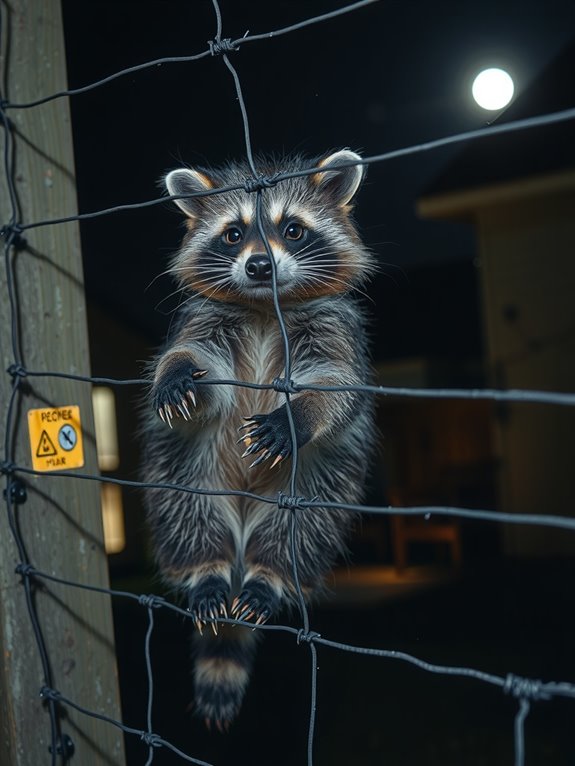
Electric fencing works as another layer of protection in my raccoon defense system. Raccoons can climb, but they won’t climb when they know they’ll get shocked. Here’s what I do: I install an electrified wire around the top of my fence or at climbing points. When a raccoon touches the wire, it gets a non-lethal shock that’s uncomfortable but safe. I’ve seen raccoons jump back and hiss right after contact, then leave the area. They learn from that bad experience and avoid my property.
The way it works is simple. The shock startles them enough that they don’t want to try again. I’m basically teaching them that my fence is a bad idea. Most electric fence systems run on batteries or solar power, so I can set them up anywhere in my yard without needing an outlet. Solar-powered systems like the Fi-Shock Solar Powered fence charger cost around $100 to $200 and work well for properties that get good sunlight.
I combine electric fencing with physical barriers like fencing or netting for the best results. That combination makes my yard much less appealing to raccoons looking for entry points.
Smooth Surfaces and Ceiling Designs That Block Entry
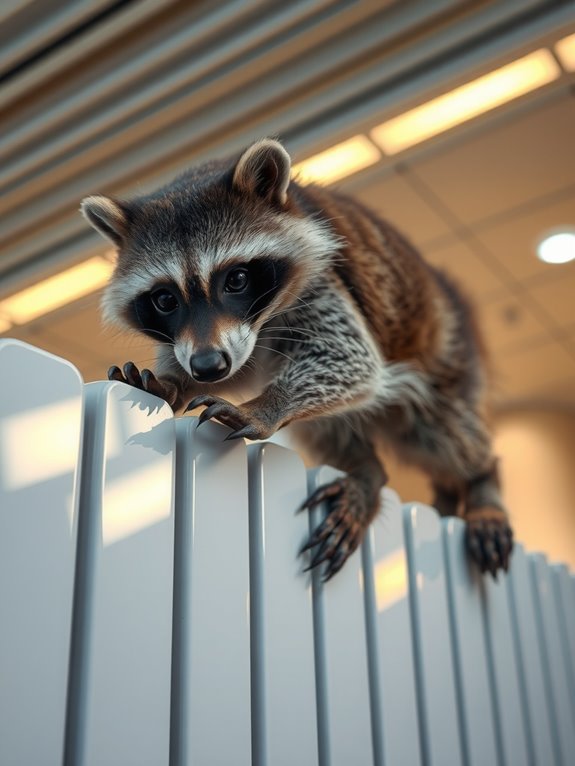
How do I stop a raccoon that’s already climbing my fence? I’ve found that smooth surfaces work really well for blocking entry without hurting the animal. Here’s what I do:
I wrap fence corners with sheet metal to remove the grip points where raccoons dig their claws in. I apply smooth coatings on vertical edges so their claws can’t get traction. I install a surface ceiling (also called an angled extension or overhang) over my yard fence to block them from climbing directly over the top from the lawn side. I combine these smooth materials with deterrent wiring for multiple layers of protection.
Raccoons need something to grip when they climb. I take that away by making surfaces slippery and smooth. The aged or weathered textures on my fence actually offer more grip than newer materials, so I focus on keeping the surfaces I’m protecting as new and untreated as possible.
I check my materials regularly since weathering happens over time. Sheet metal stays smoother than wood, and commercial fence coating products made for animal deterrent (like those marketed for climbing pest control) last longer than basic paint. When I pair these methods together, I create a setup that tells raccoons to find another route while keeping them safe and protecting my property.
Why Raccoons Keep Returning to Failed Spots
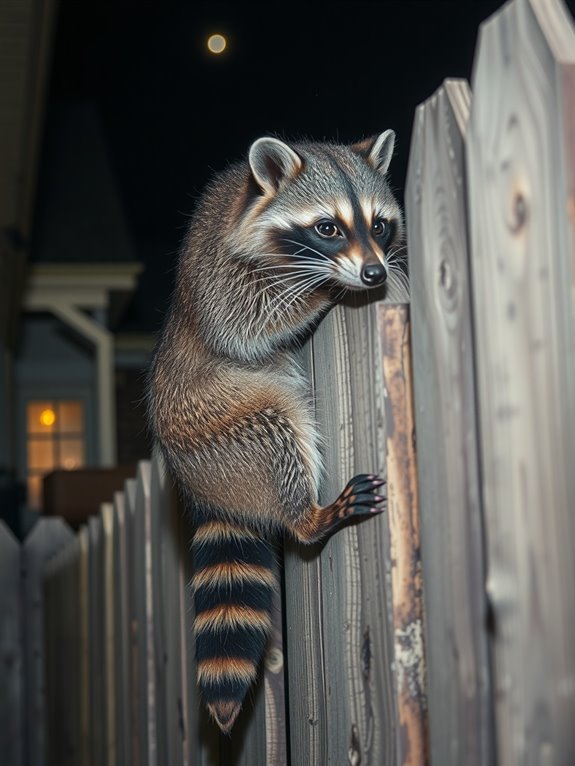
I’ve been watching raccoons test the same fence spots over and over. Even after I blocked the smooth sections and added overhead barriers, they keep coming back to those familiar routes. Here’s what I figured out.
Raccoons have this ability to remember where they’ve gotten in before. Their flexible ankles and dexterous front paws make them natural problem-solvers on vertical surfaces. They don’t just try once and move on. Instead, they adjust their approach and keep testing the same spots night after night.
I realized they’re thinking in terms of pathways. They recognize trees near my fence as stepping-stones to higher entry points. When one route fails, they don’t give up easily. They just try a different angle at that same location.
That’s why I need to eliminate their remembered pathways completely. Blocking one climbing method isn’t enough if they can still access the same general area through another way. I have to make every familiar route physically impossible to use, not just more difficult.
Which Solution Works Best for Your Yard
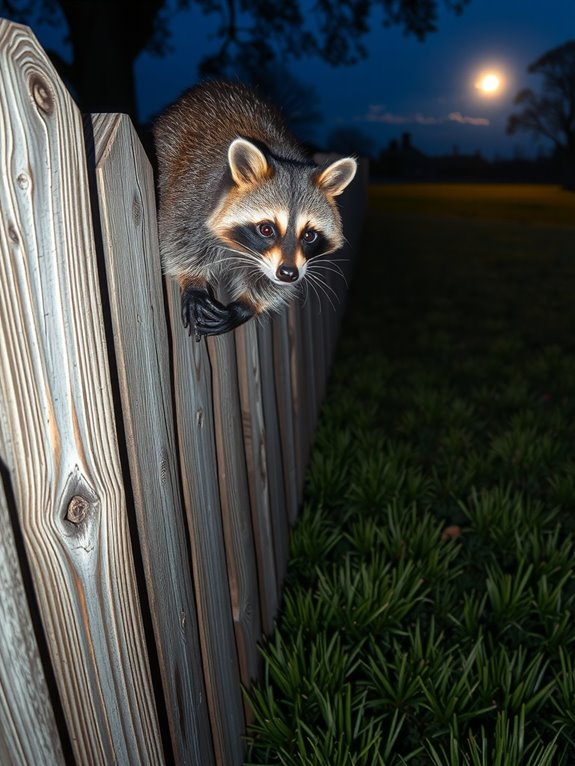
So what’s the best way to stop raccoons from climbing your fence? I’ve found that combining multiple solutions works better than relying on just one approach. Given how well raccoons climb, I want to layer my defenses strategically.
Here are the proven methods I’d try:
- Install smooth, non-climbable surfaces over fence tops to eliminate grip
- Wrap metal sheets around corners to create harder edges
- Set up electrical deterrent fences that deliver harmless shocks
- Trim tree branches within three feet of your fence line
- Use motion-activated lights near problem areas
I recommend starting with branch trimming since it costs nothing. I’d grab my pruning shears and cut back any branches hanging over my fence. Next, I’d add metal wrapping to vulnerable corners. Metal sheets are slippery, so raccoons can’t get a foothold. Finally, I’d consider an electrical fence if issues persist. This combination stops most raccoons without causing harm. I’m basically building layers that make climbing too difficult and uncomfortable for them.
Building Your Multi-Layer Raccoon Defense System
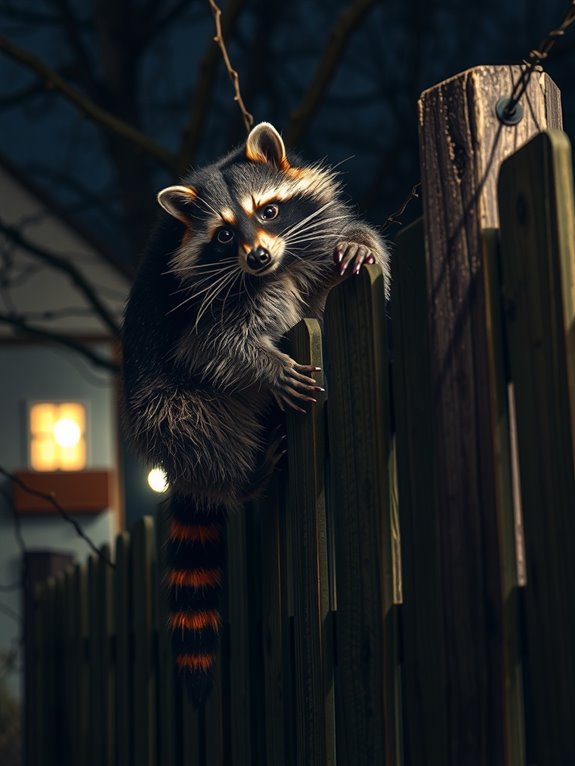
Now that I’ve got individual tactics lined up, it’s time to stack them together into a real barrier that actually works. I’m talking smooth surfaces, ceilings, and electric deterrents working as one system.
I’ll start by wrapping sheet metal around fence corners. This eliminates climbing grip. Sheet metal is smooth and slippery, so raccoons can’t get their claws to catch. I’d use 26-gauge galvanized steel sheets, about 2 feet wide, and attach them with bolts every 6 inches.
Next, I install a ceiling over my yard perimeter. Think of it as a physical no-entry zone that stops raccoons before they attempt climbing. I can use PVC-coated chicken wire or hardware cloth (1/2-inch mesh) attached to a wooden frame about 8 feet above ground. This creates a barrier they can’t climb over or push through.
Finally, I add electric fencing for that non-lethal shock. When a raccoon touches it, they’ll get startled and avoid returning. I’d use a solar-powered electric fence charger rated for raccoons, with wire spacing at 3-inch intervals and at least 4,000 volts output. The wire height should be about 6 inches off the ground where raccoons typically enter.
These three layers combined create something raccoons simply won’t breach. I’m not just blocking one entry point. I’m building a protection system that covers my entire space from skilled climbers.